
Do You Need a Septic Repair or a Full Replacement in Pennsylvania?
Most failing septic systems fail at one part, not everywhere at once. Penn State Extension looked at Pennsylvania’s on-lot sewage permits. About 20 to 25 percent of them are for repairs. Nearly 52 percent of those repairs were mechanical failures like tanks and pumps.
The money follows the same split. National cost guides put single-part septic repairs between about $250 and $5,000. A full new system in Pennsylvania costs more. One Pennsylvania cost guide lists $7,000 to $18,000 for a conventional gravity system. It puts a sand mound at $15,000 to $30,000. The dividing line is the absorption area. If the soil under the field still takes water, you are looking at a repair. If it has sealed up, you are looking at a new system.
What are the signs that a septic system is failing?
The EPA lists the signs to watch for. Sewage backing up into drains and toilets. Tubs, showers and sinks draining very slowly. Gurgling in the plumbing. Standing water or damp spots over the tank or the drainfield. Sewage odors around the tank or the field. Bright green, spongy grass over the system, even in dry weather.
None of those signs tells you which part failed. A backup can come from a crushed line, a broken baffle or a settled distribution box. It can also mean the field has quit. Finding the cause is the first step in any septic system repair.
One cause is worth ruling out early: water the system was never built to take. The EPA points at roof runoff and sump water sent onto the drainfield. On hillside lots around Pike County, surface water crosses the field on its way downhill. Moving it with yard drainage work takes load off a field near the edge.
What parts of a septic system can be repaired?
A lot of a septic system is repairable in place. The pieces that fail most often are the cheapest to put back.
Tanks. Concrete tanks crack and lids break. Steel tanks rust through. A tank can be replaced without touching the drainfield.
Baffles. The inlet and outlet baffles hold solids in the tank. When the outlet baffle breaks, solids run out to the field and start plugging it. Catching a broken baffle early protects the field.
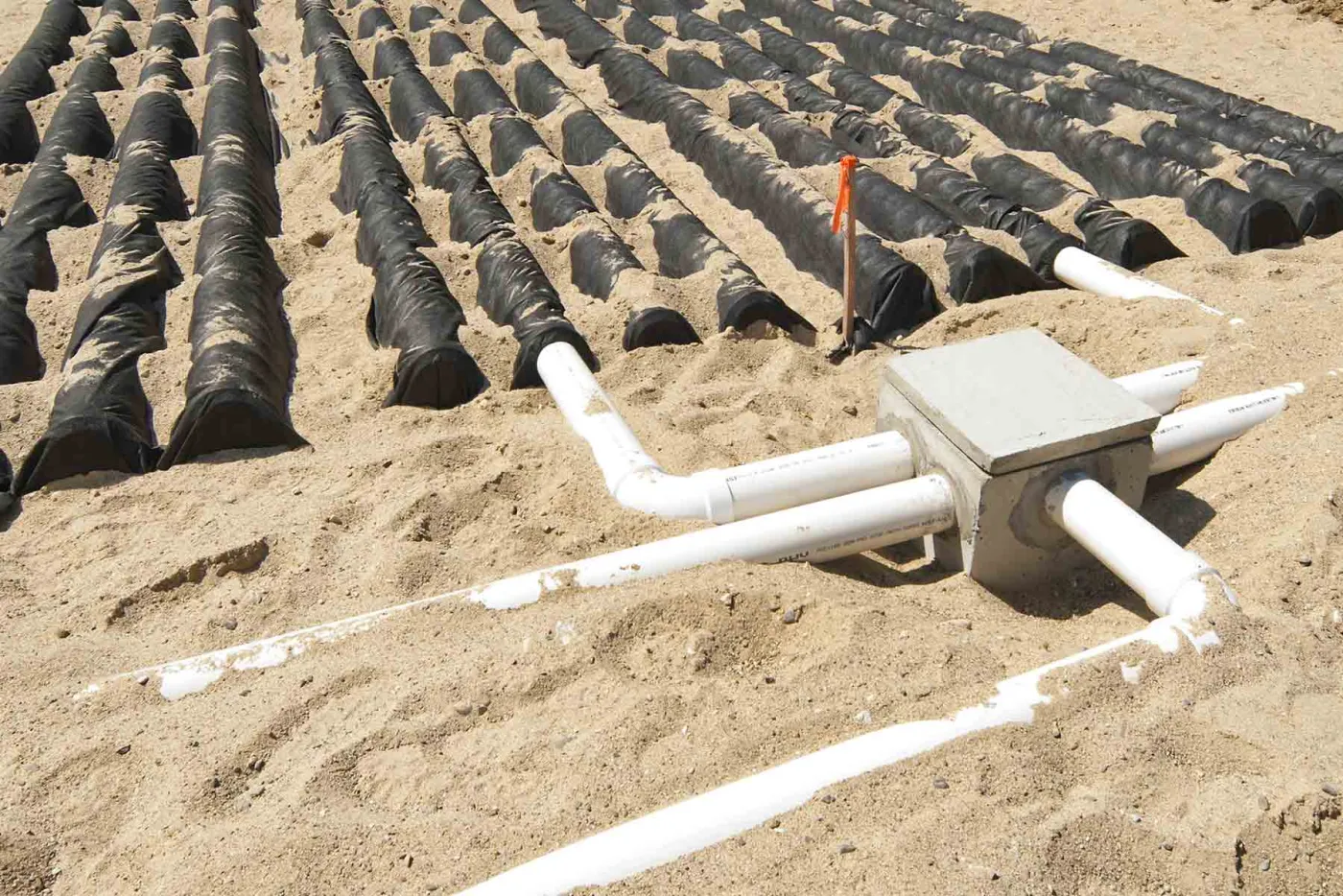
Distribution box. The D-box splits flow between the drainfield lines. When it settles or cracks, one line takes everything and that section floods. Resetting or replacing the box is one of the smaller jobs.
Lines. Roots find the joints. Trenches settle and lines belly. Equipment crushes shallow pipe. The failed run gets replaced and bedded on stone.
Risers and lids. Buried lids get raised to the surface so the tank opens easily.
When is the drainfield or absorption area done?
The drainfield is the part you cannot fix with a new part. Wastewater soaks into the soil through the trench bottoms and sidewalls. Over years a dense biological layer builds on those surfaces. The soil stops accepting water, and it has nowhere to go but up.
Sometimes only one section is gone, and replacing that run brings the field back. Other times the whole absorption area has sealed. The tell is water that never recedes. Standing water and soft ground sit over the field weeks after the last rain. The tank fills right back up after it is pumped out.
When the absorption area is done, the fix is a new absorption area. In most cases that means a new septic system installation. Around Milford, the replacement field is often an elevated sand mound. Shallow sandstone and shale bedrock runs under much of Pike County. The soils above it are slow glacial till. That is why sand mounds are common here.
What does a septic repair cost compared to a new system?
Here is what published guides list. These are market numbers, not our price list, and not a quote for your lot.
| The work | What it addresses | Published market range |
|---|---|---|
| Riser and lid on the tank | Lids buried below grade | $100 to $400 |
| Baffle repair or replacement | Solids escaping the tank | $250 to $900 |
| Distribution box replacement | One line taking all the flow | $500 to $1,500 |
| Line repair | A root break or one crushed spot | $200 to $800 |
| Line replacement | A bellied or collapsed run | $1,250 to $4,250 |
| Drainfield repair, part of the field | One failed section of the field | $1,000 to $5,000 |
| Septic tank replacement | A cracked, collapsed or rusted-through tank | $3,000 to $15,000 |
| Absorption area replacement | Soil that has sealed up | $2,000 to $20,000 |
| New conventional system, Pennsylvania | Tank and field both new | $7,000 to $18,000 |
| New sand mound system, Pennsylvania | Elevated field for slow soils or shallow rock | $15,000 to $30,000 |
The guides do not agree on tanks. One national guide lists $3,000 to $7,000 for a tank replacement. Another lists $9,500 to $15,000. Depth, access and whether the old tank comes out explain most of that spread. Rock explains the rest. Digging in ledge takes a hammer and time, and Pike County has plenty of it.
What does the sewage enforcement officer require for a repair versus a replacement?
In Pennsylvania the permit comes from your township or borough sewage enforcement officer. The state rule is specific about repairs. Under 25 Pa. Code 72.22(b), a permit is required for two kinds of work. One is “the repair, replacement or enlargement of a treatment tank.” The other is “the repair, replacement, disturbance, modification or enlargement of a soil absorption area.”
That draws the line clearly. Replacing a tank takes a permit. So does digging into the absorption area, whether you are fixing one lateral or building a whole new field.
What changes between a repair and a replacement is the testing behind the permit. A tank swap or a D-box reset gets judged on the system already in the ground. A new absorption area sends the officer back to the soil. That means test pits, a look at the soil profile and, where the design calls for it, a percolation test. We dig those pits for the officer. The design itself comes from the officer, or from a soil scientist or engineer where the county requires one.
How do New Jersey and New York handle septic repairs?
Across the river the office changes. In New Jersey, systems fall under N.J.A.C. 7:9A, the state standards for individual subsurface sewage disposal systems. Local health departments issue the permits for location, design, installation, alteration and repair. Sussex County points residents to its Office of Environmental Health.
New York runs through the county as well. Residential systems follow state health department standards, and the county health department permits the work. In Orange County or Sullivan County, start there rather than with the town.
Where should you start?
Get the system opened and looked at before anyone talks about a number. The tank level, the D-box and the ground over the field answer most of the question.
Sawkill Environmental repairs failing systems and installs new ones around Milford. We work across the Pennsylvania, New Jersey and New York corner. We are licensed and insured, PA HIC #PA225040, and we run our own excavators. Start with the repair side of the work and we will tell you plainly if the absorption area is done. Estimates are free, so call or text (973) 552-8580.