
Concrete vs Plastic Septic Tank: Which Is Better in Pennsylvania?
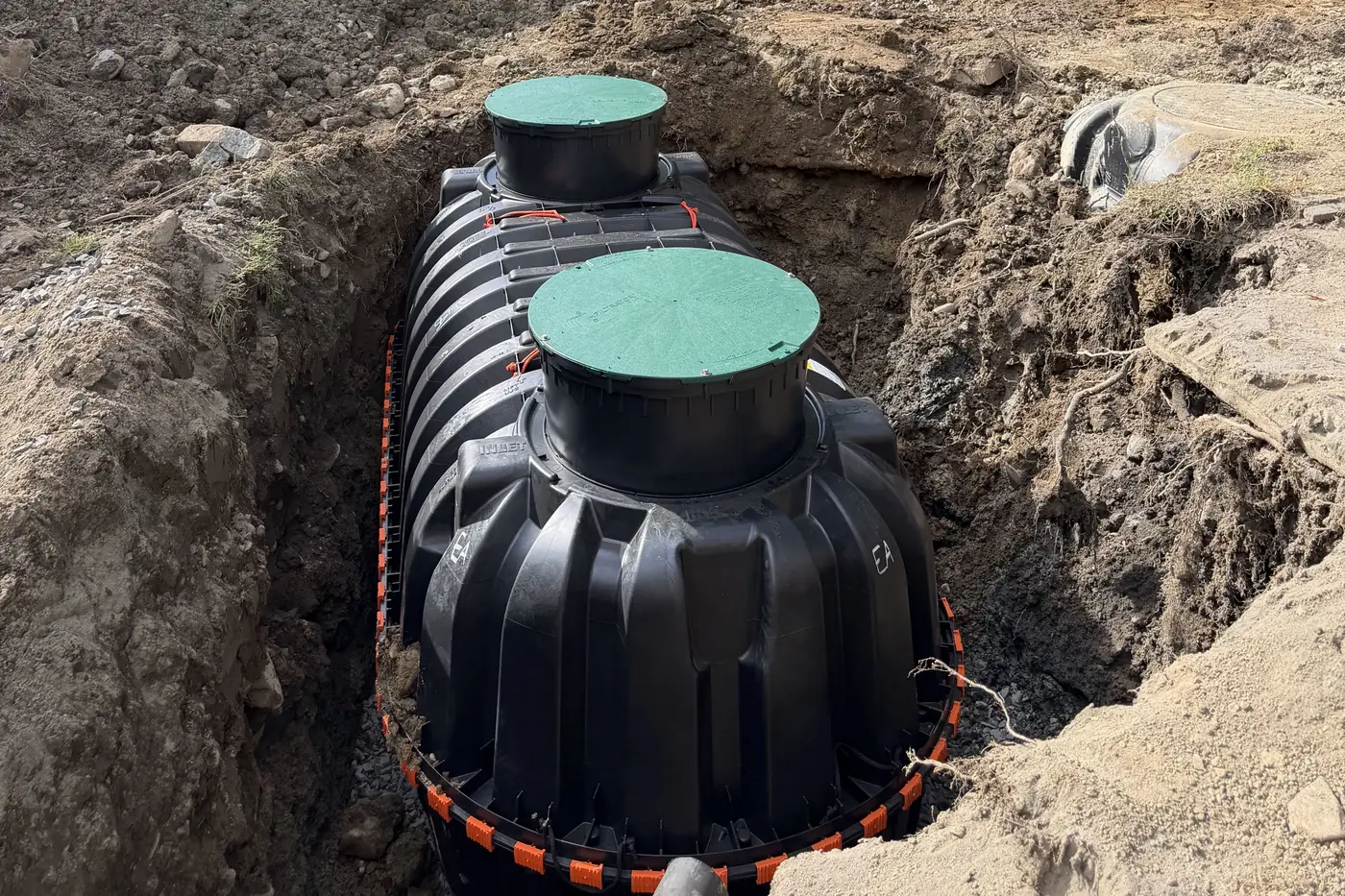
Both can be the right tank, and Pennsylvania’s code does not pick a winner. Concrete is heavy, so it stays put in wet ground. It usually takes a crane or a large excavator to set, and it can crack over time. Plastic is light enough for a tight or wooded lot, and it resists cracking and rust.
The catch with plastic is the install. It has to be bedded well, backfilled in lifts, kept off rock and held down where groundwater rises. It also can’t be buried as deep. So your lot decides, and the choice comes up with every new septic system installation and every septic system replacement.
What does Pennsylvania require of a septic tank?
The rule is 25 Pa. Code 73.31. Every tank must be watertight and built of sound, durable material not subject to excessive corrosion or decay. Plastic is not named in the rule, and it is not ruled out.
The code does name a few materials. Precast concrete tanks need walls at least 2 1/2 inches thick, adequately reinforced. Steel tanks have to meet a federal standard. Tanks of 5,000 gallons or less cannot be built of block, brick or other masonry.
Size comes from the home’s daily flow. A house is figured at 400 gallons a day, plus 100 gallons for each bedroom over three. The minimum tank is 900 gallons, and the code’s table puts a four-bedroom house at 1,250 gallons. Every installation needs a tank with at least two compartments, or two tanks connected in series.
The tank top, or its manhole riser, can sit no more than 12 inches below grade. Under 25 Pa. Code 72.30, no part of the system can be covered until a final inspection and written approval. Your sewage enforcement officer does that inspection. This is general information, not legal advice.
How do concrete and plastic septic tanks compare?
Weight is concrete’s big advantage. A university extension article says that weight keeps a concrete tank firmly in place underground. That makes it much less likely to shift or float where groundwater runs high.
Concrete has two weak spots. It can crack from soil movement or from freezing and thawing. Once it cracks, groundwater can leak in or wastewater can leak out.
Sewer gas is the second. A University of Minnesota septic manual says hydrogen sulfide can become sulfuric acid above the sewage. Concrete tanks are prone to corrosion under those conditions, which is one reason tanks are vented.
Light weight is plastic’s edge. The extension article says plastic tanks need less heavy machinery, which suits places with limited access. They resist cracking and rust. Most are molded as a single piece, so there are fewer seams to leak.
The care goes into the hole. A 2025 Pennsylvania inspection training deck, written by a sewage enforcement officer, lists the checks for plastic tanks. It calls for good bedding and backfill placed in lifts to fill voids. It says to protect the tank from rock puncture and from buoyancy.
The same deck puts the usual burial limit at 36 inches for plastic. For non-load-bearing concrete tanks, it is generally 48 inches. The Minnesota manual adds that plastic tanks float more readily than concrete where water tables run high. Any tank set below seasonally saturated soil has to be anchored or heavy enough not to float when empty.
What about fiberglass and steel septic tanks?
Fiberglass is the third choice. It is light like plastic, so the Minnesota manual flags the same flotation and installation concerns. A national cost guide updated in June 2026 says fiberglass won’t crack but can shift in the soil.
Old steel tanks rust out, and a second national guide notes buried steel has ample chances to rust or corrode. When the tank is the only failed part, a tank-only replacement falls under septic repair.
Why does the lot decide so much in Pike County?
Rock sits close to the surface here. USGS reports that less than half of Pike County is covered by glacial deposits. Most of that cover is till, typically under 6 feet thick. Bedrock is exposed at the surface in many areas.
The Minnesota manual says a tank hole with rocks in the bottom needs bedding material. A hole cut into rock or dense soil can also hold water. The looser backfill lets water collect around the tank, even when the ground nearby is not saturated. That water pushes up on the tank, and a light tank has less weight holding it down.
Milford Borough and Milford Township rely solely on on-lot systems, per the 2021 Act 537 sewage plan. The plan notes that many of those systems predate the 1969 construction rules. In its Matamoras study area, 53 percent of the on-lot systems inspected had potential, suspected or confirmed malfunctions. A replacement tank goes in under today’s code, in whichever material fits the lot.
What do concrete and plastic septic tanks cost?
National cost guides price the tank by material. These are market numbers, not our price list, and not a quote for your lot.
| Tank or line item | Published national range | What the guide notes |
|---|---|---|
| Concrete tank, material only | $700 to $2,000 | Durable but may crack over time |
| Plastic tank, material only | $500 to $2,000 | Light and resists cracking, but can be damaged during installation |
| Fiberglass tank, material only | $1,200 to $2,000 | Strong and won’t crack, but can shift in the soil |
| Plastic tank, second guide | $830 to $1,900 | Light, and resists rust and cracking |
| Installing a tank, three to four bedroom home | $1,500 to $4,000 | Often costs more than the tank itself |
All rows but one come from the June 2026 guide. The second plastic row is from the guide last updated in January 2023.
The ranges overlap, and the sources split on which costs less. The 2009 Minnesota manual called concrete generally lower in cost. The extension article says plastic is usually cheaper to buy and easier to install.
Either way, the tank is often the smaller part of the bill, as the last row shows. The extension article adds that a concrete tank’s weight raises labor and equipment costs.
Size moves the price as well. The same June guide pairs a 1,000-gallon tank with a three- or four-bedroom home. Pennsylvania’s table puts a four-bedroom house at 1,250 gallons, so get prices for the size your design calls for.
Which septic tank fits your lot?
Start with the ground and the way in. Wet ground with an open path for a truck plays to concrete’s weight. A tight or wooded lot favors plastic, bedded with care and anchored where water rises. When the house sewer leaves the foundation deep, check the tank’s burial limit.
The treatment tanks in aerobic septic systems face the same groundwater question. The Minnesota manual says any tank can be lifted out of saturated soil.
Sawkill Environmental installs new septic systems and full replacements around Milford. We dig the test pits for the sewage enforcement officer, then build to the approved design. That design and the permit run through the officer, with a soil scientist or engineer where one is required.
We are licensed and insured, PA HIC #PA225040, and we run our own excavators and equipment. We work across the Pennsylvania, New Jersey and New York corner. See how a full replacement runs, then call or text (973) 552-8580 for a free estimate.