
What Is a Perc Test in Pennsylvania and What Does It Cost?
Published national cost guides put a perc test at about $600 to $800, with one guide reporting a $725 average. A second national guide reports a wider band of $750 to $1,850, with a $1,300 average. Your township charges its own fee on top of that. Delaware Township in Pike County posts $250 for perc testing and another $250 when the septic permit is issued. These are published market numbers, not our price list.
A perc test in Pennsylvania is not a soil test you order on its own. It is the second half of a site investigation run under 25 Pa. Code Chapter 73. Your township or borough sewage enforcement officer runs it. The soil probe comes first, and the percolation test only happens if the soil profile allows it.
What does a perc test cost in Pennsylvania?
Two costs stack up. The first is the testing work, which national cost guides price. The second is the fee your township sets. Pennsylvania rules let each local agency set its own fee schedule. That number changes when you cross a town line.
| Item | Published figure |
|---|---|
| Perc test, one national cost guide | $600 to $800, average $725 |
| Perc test, a second national cost guide | $750 to $1,850, average $1,300 |
| Quarter acre lot, one test hole | $150 to $250 |
| One acre lot, two test holes | $600 to $900 |
| Five acre lot, three test holes | $1,100 to $2,000 |
| Testing labor, hourly | $100 to $250 per hour |
| Licensed engineer added to the test | $200 to $500 |
| Soil scientist added to the test | $150 to $400 |
| Delaware Township, Pike County: perc testing application | $250 |
| Delaware Township, Pike County: septic permit | $250 |
The machine work that opens the test pits is usually billed on its own. One guide notes that a test needing a backhoe runs at least $200 higher than a hand dug one. Most people paying for a perc test around here want a new septic system installed on the lot. The test is the first slice of a much larger budget, so treat the table as a planning range.
Who runs a perc test in Pennsylvania?
Pennsylvania DEP lays out the order. The lot owner applies for a permit through the local sewage enforcement officer. That officer conducts the soil profile examination and the percolation tests that decide site suitability. The owner then completes the application with a system design built on those results.
The officer approves or denies the permit within seven days of a complete application. The same officer has to inspect the finished system before it gets covered. A homeowner cannot run the test alone and turn in the numbers.
A permit is also required when a repair replaces or enlarges a treatment tank, or disturbs the absorption area. That puts a failing system in front of the same office.
What do the perc test numbers mean?
Two readings decide your system. One is the depth to the limiting zone. That is the rock or seasonal water table the officer finds in the profile. The other is the average percolation rate, written in minutes per inch.
| What the testing finds | What Pennsylvania allows |
|---|---|
| Limiting zone within 20 inches of the mineral soil surface | No percolation test, permit denied |
| Less than 20 inches of suitable undisturbed mineral soil | No absorption area |
| Limiting zone less than 60 inches down | Elevated sand mound required |
| Limiting zone 60 inches or deeper | In-ground absorption area allowed |
| Perc rate 6 to 60 minutes per inch | In-ground gravity absorption area |
| Perc rate 61 to 90 minutes per inch | In-ground, with pressure dosing required |
| Perc rate 3 to 5 or 91 to 180 minutes per inch | Elevated sand mound or subsurface sand filter |
| Perc rate under 3 or over 181 minutes per inch | Unsuitable for either |
Around Milford the limiting zone is usually shallow sandstone or shale. On other lots it is a seasonal water table sitting in glacial till. Either one puts the 60 inch line out of reach. The design comes back as an elevated sand mound instead of a buried bed. Penn State Extension puts in-ground gravity fields at 6 to 60 minutes per inch, which matches the state table.
Why would a property fail a perc test?
Sometimes the perc test never happens at all. Pennsylvania does not allow percolation testing where the limiting zone sits within 20 inches of the mineral soil surface. The permit is denied right at the soil probe.
Site conditions can rule an area out on their own. A proposed absorption area is unsuitable when the slope is greater than 25%. A rock outcrop inside the area rules it out too. So does federal flood mapping that calls the ground a floodway. Absorption areas also cannot go in or on fill unless that fill has been in place at least four years.
A failed area is not always a failed lot. Soil changes fast on plateau ground, and a second spot can test very differently. The officer may also come back with a mound design on ground that will not take a buried bed.
How long does a perc test take?
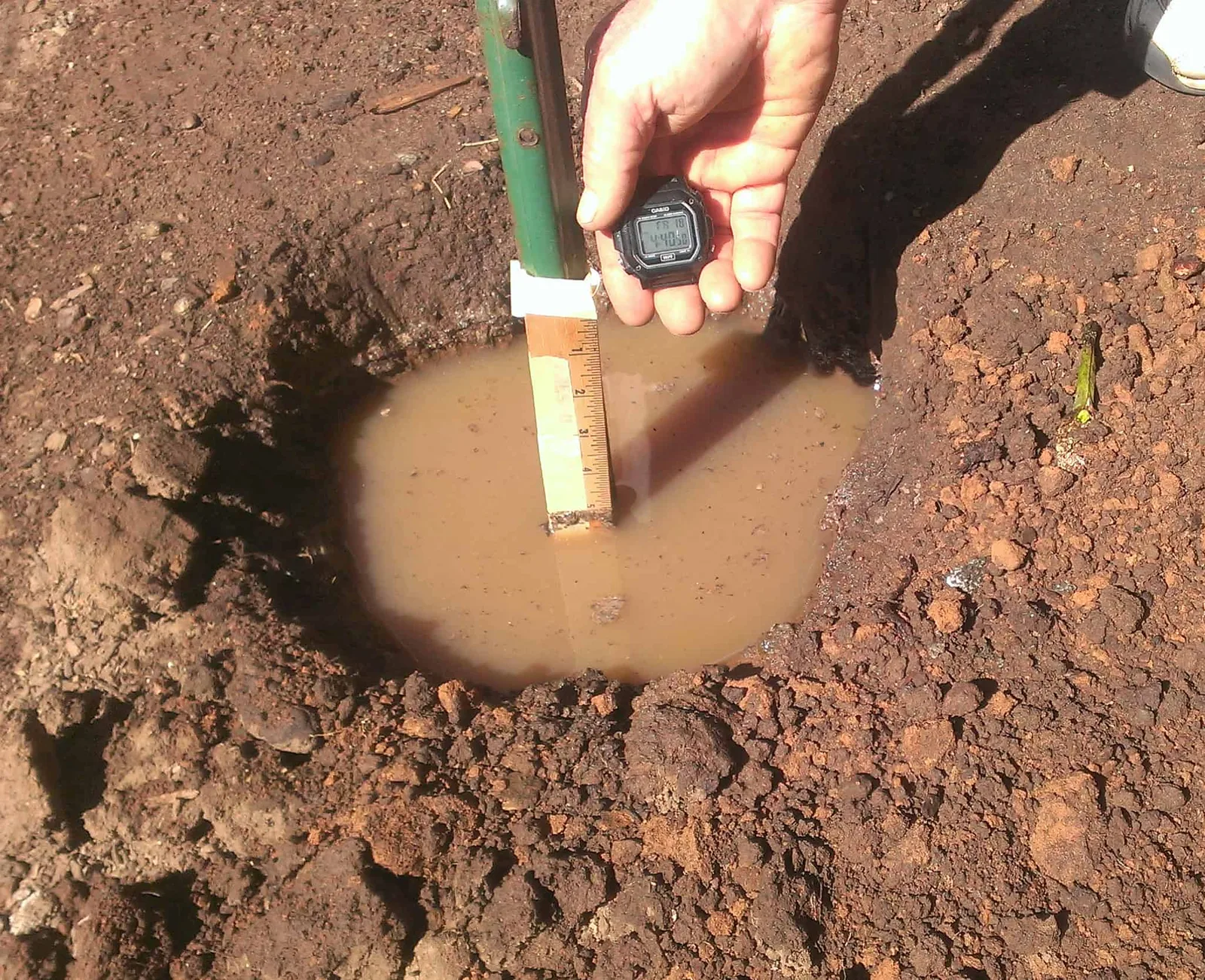
The testing runs across more than one day. Six or more holes get dug in separate spots spaced over the proposed absorption area. They are presoaked with at least 12 inches of water over the gravel. The holes then sit undisturbed for 8 to 24 hours.
The measured part is shorter. Readings are taken at 10 or 30 minute intervals. DEP says the test may run as long as four hours or as little as 40 minutes. After the design is submitted, the officer has seven days to act on a complete application.
Township office hours shape the calendar more than anything else does. Dingman Township, for one, posts office hours Monday through Friday between 9 and 10:30 A.M. for its sewage enforcement officer. Greene Township posts its officer at the township building on Wednesdays.
Who digs the test pits?
That part is ours. We bring the excavator and open the soil probe pits where the officer wants them. Then we stand by while the profile is read. When the approved design comes back, the same equipment puts the system in and finishes the grading.
Sawkill Environmental is based in Milford and works about 25 miles out. That covers Pike and Wayne counties in Pennsylvania. Across the river it reaches Sussex County in New Jersey, plus Orange and Sullivan counties in New York. We install new septic systems and full replacements, and estimates are free. Call or text (973) 552-8580.