
French Drain vs Curtain Drain vs Swale: Which Does Your Pennsylvania Lot Need?
It depends on how the water reaches you. A French drain picks up water that is already in the ground, at a soggy spot or along a foundation. A curtain drain sits uphill and catches water moving down the slope under the surface. A swale is a shallow grassed channel that carries rain running over the top of the ground.
Many Pike County lots need two of them. A sloped, wooded lake-community lot often gets runoff on top and groundwater underneath. A swale and a curtain drain then work as a pair. Sawkill Environmental builds all three as part of French drain installation and yard drainage around Milford.
What is the difference between a French drain, a curtain drain and a swale?
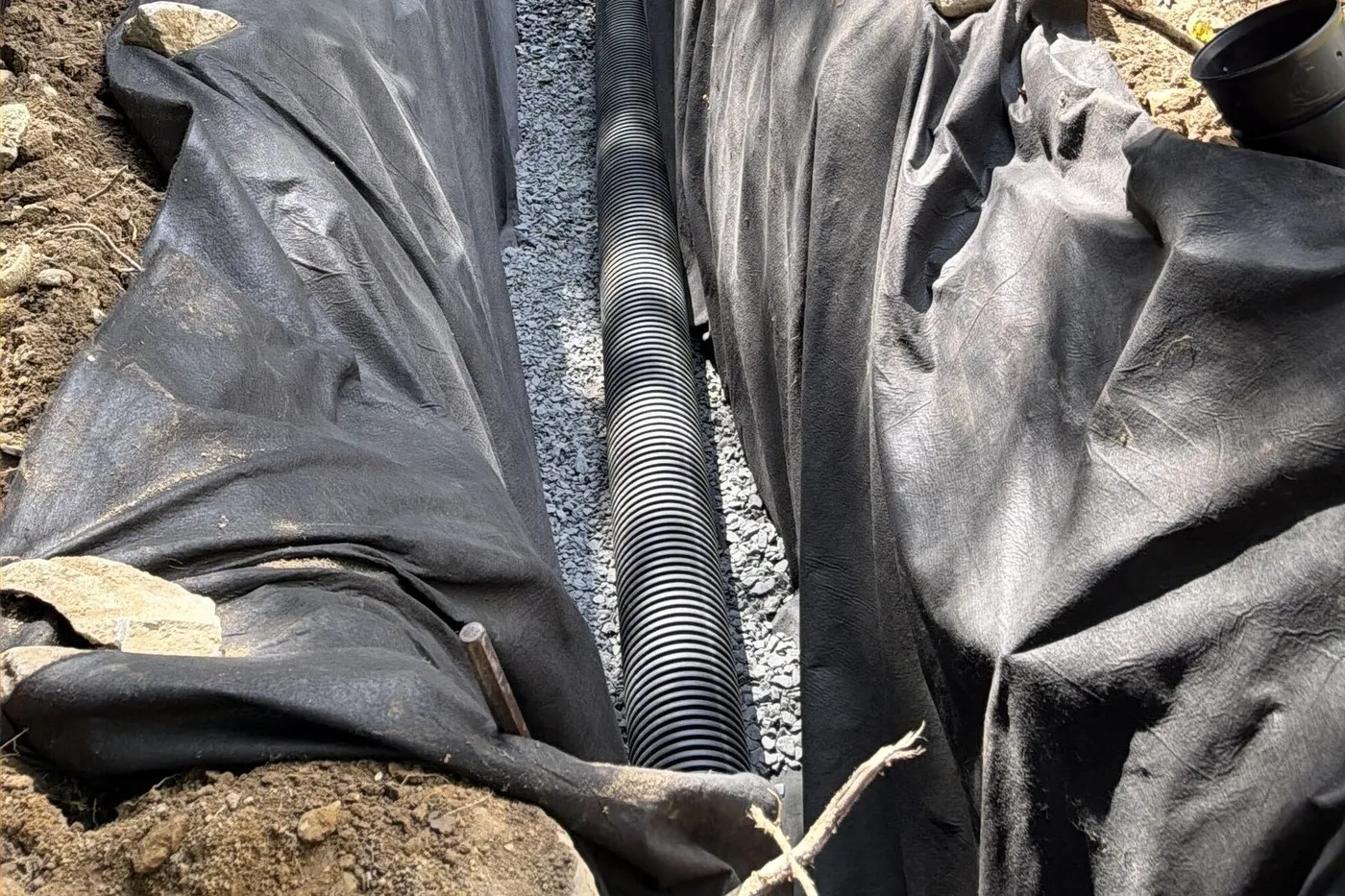
The French drain and the curtain drain are built the same way. Each is a trench lined with filter fabric and filled with washed stone, with a perforated pipe in the bottom. What changes is where the trench goes and which water it meets.
A swale has no pipe. It moves surface water with the shape of the ground.
| French drain | Curtain drain | Swale | |
|---|---|---|---|
| Water it handles | Water already in the ground at a wet spot or a foundation | Groundwater moving downhill under the surface | Rain and snowmelt running over the ground |
| Where it goes | In the wet spot, or down along the footing of the house | Across the slope, uphill of the house or the septic area | Along the fall of the lot, out to a safe outlet |
| How it is built | Washed stone and perforated pipe in a fabric-lined trench, piped to daylight | The same trench and pipe, cut across the hill and piped to daylight | A broad, shallow channel with gentle grassed sides and no pipe |
| Typical depth | Down into the wet soil; at a basement, down at the footing | Down into the wet layer the water moves through | Shallow; the state manual designs for about 12 inches of water on average |
For prices, national market ranges are in our French drain cost guide.
Which one does your wet yard or basement need?
Start with where the water shows up and when.
Water sitting on top after a storm points to a swale or regrading. The International Residential Code has the ground fall at least 6 inches in the first 10 feet from the foundation. Where a slope or a wall rules that out, the code calls for drains or swales.
Ground that stays soggy for days points to a French drain. So does a basement wall that stays damp near the floor. At a basement, that drain is a footing drain run out to daylight.
Water that arrives from uphill, long after the rain stops, points to a curtain drain. It often shows as a wet band across a slope or a spring line above the house. Wet ground over a septic absorption area is a separate case. It can mean a failing septic drainfield, so check that first.
Why do Pike County lots get both kinds of water?
The ground here is thin. A 2017 USGS report on Pike County found the glacial till is typically under 6 feet thick. It also found bedrock exposed at the surface in many areas.
The soil adds a second barrier. The 2021 Eastern Pike County sewage plan lists Mardin soils around Milford, Matamoras and Westfall. The USDA’s official description of Mardin soil puts a dense fragipan 14 to 26 inches down. Its seasonal water table typically sits 14 to 24 inches below the surface.
Water moves easily in the upper soil and slowly in the layers below it. So it travels sideways above that dense layer, down the slope. The same description rates the soil’s surface runoff potential medium to high. One hillside can send water at a house over the ground and under it.
That is why depth matters for a curtain drain. The trench has to reach the wet layer to catch it. On Mardin soil, a trench only a foot deep stops above that seasonal water table.
How is each one built on a hillside lot?
A French drain trench goes down into the wet soil, and its pipe falls to an outlet at daylight.
Along a basement, the drain sits down at the footing. Under the International Residential Code, the stone reaches at least 1 foot past the footing. It rises at least 6 inches above the top. The pipe rests on at least 2 inches of washed stone, with 6 inches or more over it.
A curtain drain uses the same trench and pipe, cut across the slope above what you want to protect. It goes deep enough to reach the wet layer. From its low end, the pipe carries the water out to daylight. Where the trench meets ledge, we break the rock out with excavators.
A swale is a broad, shallow channel in Pennsylvania’s Stormwater Best Management Practices Manual. Its bottom runs 2 to 8 feet wide, and its sides slope gently, at 3:1 to 5:1.
The manual recommends a fall of 1 to 3 percent along the length. Steeper than 3 percent, it recommends check dams to slow the water. It designs for shallow water: a 12 inch average, and 18 inches at most at the low end. Where a swale crosses a road, a culvert carries the water under it.
When do you need two of them together?
On a sloped lot, these pairs make sense:
- A swale and a curtain drain, both uphill of the house. The swale carries runoff on the surface. The curtain drain catches the water moving underneath.
- A footing drain and regrading. The drain handles water at the wall, and the new grade keeps runoff from reaching it. Buried downspout lines run out to daylight with them.
- A curtain drain above a septic area. It cuts off hillside water before it reaches the absorption area.
A swale on soggy ground stays soggy. EPA guidance sets a dry swale’s bottom at least 2 feet above the groundwater table. That keeps it from staying saturated. On Mardin soil, with its seasonal water table 14 to 24 inches down, pair the swale with a drain.
Every one of these needs an outlet, usually daylight at a lower point on the lot. Never tie a footing drain, a roof drain or a sump pump into a sanitary sewer. Port Jervis’s sewer use law bars footing drains, roof drains, cellar drains and sump pumps from it.
What has to happen before the digging starts?
Pennsylvania treats this work as earth disturbance. The Pike County Conservation District’s 2024 guide lists grading and excavations under Chapter 102. PA DEP requires erosion and sediment controls for any earth disturbance. A written plan is required once it reaches 5,000 square feet.
Every dig starts with 811. In Pennsylvania, the excavator calls PA One Call 3 to 10 business days before digging. Across the river it is New Jersey One Call or Dig Safely New York. This is general information, so ask your township what a specific job needs.
Where should you start with a wet lot?
Sawkill Environmental is based in Milford and handles stormwater drainage repairs across the Pennsylvania, New Jersey and New York corner. We run our own excavators and equipment, and we are licensed and insured, PA HIC #PA225040. On a new build, swales and regrading go in with site preparation and grading. Estimates are free, so call or text (973) 552-8580.