
How Much Does a French Drain Cost in Pennsylvania?
Most French drain jobs in Pennsylvania land between about $1,650 and $12,250. National cost guides put the average near $5,000. Priced by the foot, exterior drains run about $10 to $65 per linear foot in those same guides. A short run beside a garage sits at the low end. A long drain across a wet hillside sits at the top.
Those are market numbers, not our price list. They are useful because they show the spread. Two lots on the same road can get quotes thousands apart. The reason is almost always what sits under the grass.
What do national cost guides say a French drain costs?
Here is what published national guides report for exterior drainage work. Every figure below is a national range.
| Work | Published market range |
|---|---|
| Exterior French drain, per foot | $10 to $65 per linear foot |
| A 100 foot exterior run | $1,000 to $6,500 |
| Whole French drain job, small to large | $1,650 to $12,250, average about $5,000 |
| Curtain drain | $10 to $35 per linear foot, or $1,500 to $8,800 |
| Yard regrading and reshaping | $500 to $5,000 |
| Drain pipe, material only | $0.50 to $3 per linear foot |
| Gravel and stone, material only | $10 to $60 per cubic yard |
| Sod repair after the work | $0.30 to $0.80 per square foot |
| Interior basement drain, a different trade | $40 to $100 per linear foot |
Guides build those averages from every state. Pennsylvania lots in the Poconos and the Delaware valley often price above the middle of the range. The digging is harder here. We do French drain installation and yard drainage around Milford, and the trench is rarely simple.
What drives the price on a Pocono or Delaware valley lot?
Rock ledge is the first thing. Pike County sits on shallow sandstone and shale, with glacial till and boulders above it. A trench that hits ledge stops being a trench and becomes rock work. Breaking rock adds machine hours, and hours are what a drainage price is built from.
Clay and tight glacial soil come next. Water does not soak into that ground. It runs sideways under the topsoil until something stops it, usually a foundation wall. Slow soil means more pipe and more stone to catch the water first.
Then there is grade and depth. A hillside lot pushes runoff at the back of the house every spring. The drain has to sit deep enough to catch that water. A deeper trench is a wider trench, and that means more spoil to move. Depth moves a job from the bottom of the per foot range toward the top.
The outlet decides the rest. Every French drain needs somewhere to send water. Running the line out to daylight on a sloping lot is the cheapest ending. A flat lot needs a longer run or a piped line to a catch basin. Rock in that outlet run is rock excavation work, the same as any other trench.
French drain, curtain drain, regrading or catch basins?
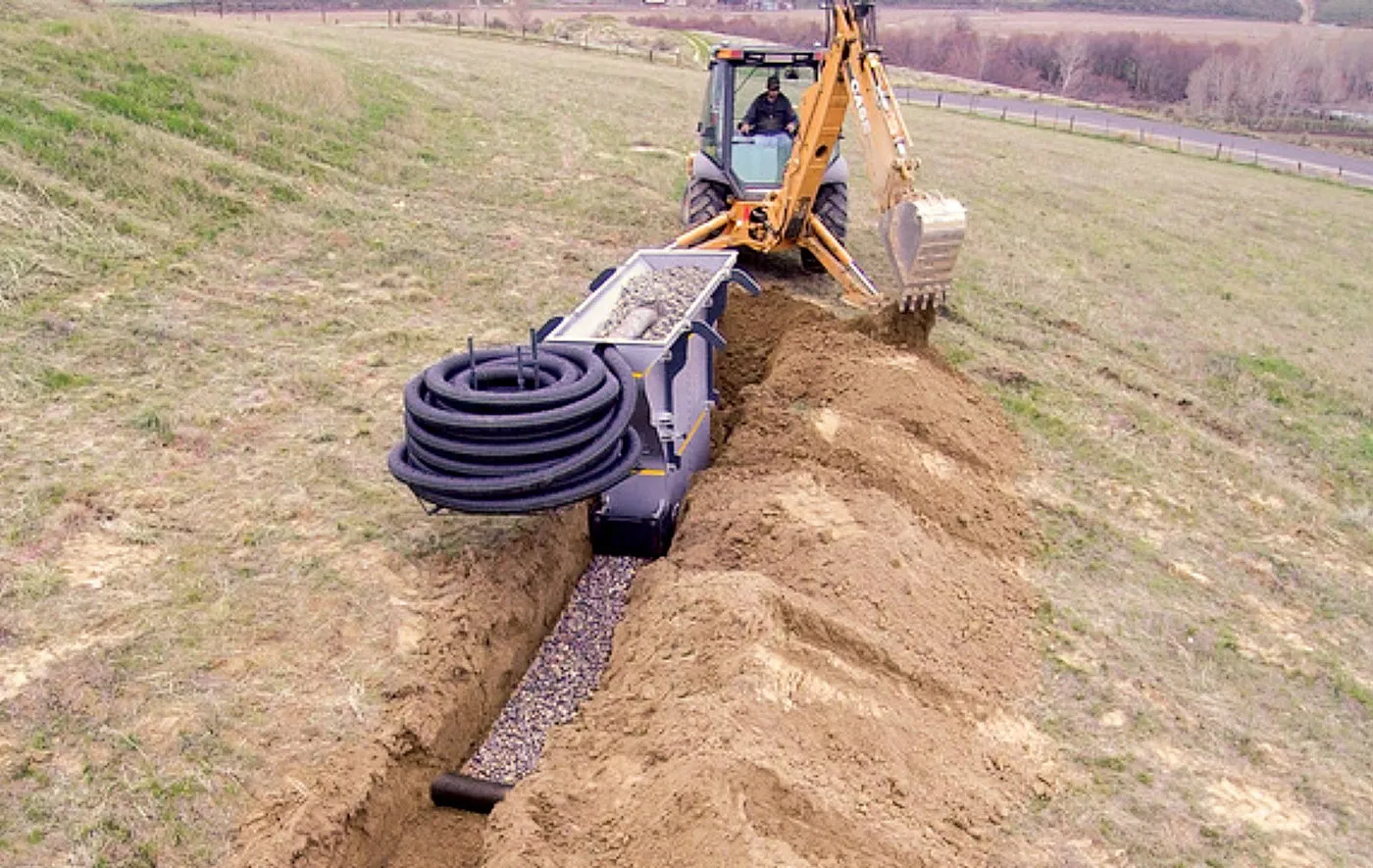
A French drain is a gravel filled trench with perforated pipe. It picks up water in the ground and moves it away. It goes along a foundation, across a wet lawn, or at the toe of a slope.
A curtain drain sits uphill of what you are protecting. It cuts off water moving down the hill before it reaches the house or the septic area. One national guide describes curtain drains as shallower, around 9 to 12 inches deep. Less depth is part of why they can price lower per foot.
Regrading and swales move surface water with shape instead of pipe. A shallow grassed swale can carry a lot of runoff for less money than a pipe system. Guides put yard regrading at roughly $500 to $5,000. On a new build that work belongs with the lot grading and stone base anyway.
Catch basins and drain lines handle water that already ponds at a low spot. A basin collects it and a solid pipe carries it off. Culverts and cross pipes do the same job under a road or a lane.
Most real lots need two of these together. A curtain drain uphill paired with a swale. A French drain at the footing paired with a piped outlet to daylight.
Why do wet basements around here start outside?
Penn State Extension is plain about it. Downspouts should be directed away from foundations to avoid basement flooding. Roof water is the first thing to check on any wet basement.
Ground shape is next. If the ground falls toward the house, every rain walks toward the wall. Then comes the footing drain. On older homes it may be crushed or silted in.
Working outside is where the water actually is. Interior systems price higher per foot in the same guides, and they manage water that already reached the wall. We work outside the house, on the ground and the pipe.
Who do you call before digging a drain?
PA One Call at 811 marks public utilities before any digging in Pennsylvania. New Jersey One Call and Dig Safely New York do the same across the river. The call is free and it comes before every trench.
Earth disturbance in Pike County also involves the Pike County Conservation District. That office handles erosion and sediment control review under the state’s Chapter 102 rules. Your township office is the place to ask what a specific job needs. A contractor should raise this before the machine shows up.
What does this mean for your lot?
Start with the water. Ask where it comes from, where it will go, and what happens if the trench hits rock. A finished quote names the outlet.
Sawkill Environmental handles stormwater drainage repairs around Milford, and we cross the river into New Jersey and New York. We run our own excavators and equipment, and we are licensed and insured. Estimates are free and we look at the lot first. Call or text (973) 552-8580.